
Fire Safety Requirements for Businesses in Nairobi
Navigating workplace regulations in Nairobi can feel overwhelming, but fire safety compliance is non-negotiable. Whether you run a corporate office in Upper Hill, a retail shop in the CBD, or a restaurant in Westlands, meeting local fire safety standards is essential to protect your team, safeguard your property, and keep your business operating legally.
Failure to meet these requirements can lead to hefty fines, delays in renewing your Single Business Permit, or even forced closure by county inspectors.
This guide breaks down the core fire safety requirements every business in Nairobi must meet to stay fully protected and compliant.
1. Fire-Fighting Equipment and Fire Extinguishers
Kenyan law and Nairobi County by-laws require every commercial property to have functional fire-fighting equipment installed in accessible areas.
- Portable Fire Extinguishers: You must have at least one portable fire extinguisher for every 200m2 of floor space (or at least one per floor/section).
- ABC Dry Powder Extinguishers: Ideal for general spaces, tackling wood, paper, electrical, and flammable liquid risks.
- Carbon Dioxide (CO2) Extinguishers: Necessary near delicate electrical equipment, servers, and main power distribution boards.
- Class F / Wet Chemical Extinguishers: Required in commercial kitchens and restaurants handling hot oils and fats.
- ABC Dry Powder Extinguishers: Ideal for general spaces, tackling wood, paper, electrical, and flammable liquid risks.
- Fire Hose Reels and Hydrants: Standard requirements for larger commercial buildings, multi-story complexes, and industrial sites.
- Fire Blankets: Mandatory in kitchen spaces, food prep zones, and laboratories to quickly smother small liquid or pan fires.
2. Annual Fire Safety Audits & DOSHS Registration
Under Rule 36 of the Fire Risk Reduction Rules (2007) derived from the Occupational Safety and Health Act (OSHA 2007), businesses in Kenya are required to undergo an annual fire safety audit.
- Certified Auditors: Audits must be conducted by a DOSHS-registered Fire Safety Advisor.
- Audit Reports: The report evaluates your premises’ fire risk, existing equipment, evacuation paths, and storage of flammable materials. A copy must be submitted to the Directorate of Occupational Safety and Health Services (DOSHS).
3. Nairobi County Fire Safety Compliance
To obtain or renew your Single Business Permit in Nairobi, you must secure an annual Fire Clearance Certificate from the Nairobi City County Government.
- The Inspection Process: A County Fire Inspector will visit your premises to confirm that your extinguishers are serviced, fire exits are clear, and emergency signage is properly posted.
- How to Apply: Applications and payments are submitted online through the NairobiPay / eServices Portal under the Essential Services section.
4. Fire-Fighting Teams and Employee Training
Having fire gear installed isn’t enough—your team must know how to use it.
- Fire Marshal Ratio: Regulations require at least 1 trained fire marshal for every 50 employees (or a minimum of 2 trained staff members for smaller workplaces).
- Mandatory Fire Drills: Workplaces must conduct at least two evacuation fire drills every year to ensure staff can evacuate quickly during an emergency.
5. Clear Emergency Exits & Photoluminescent Signage
During a fire emergency, clear escape routes save lives.
- Unobstructed Paths: Corridors, stairwells, and emergency exit doors must remain completely free of boxes, furniture, or clutter at all times.
- Proper Signage: Install glowing (photoluminescent) exit signs directing staff to safe assembly points, alongside clear labels marking the exact locations of fire extinguishers and hose reels.
7. Fire Equipment Inspection and Maintenance
Extinguishers lose pressure over time or after use, making routine maintenance essential.
- Monthly Visual Checks: Verify that the pressure gauge needle sits strictly in the green zone and that safety pins/tamper seals are intact.
- Annual Servicing: All fire extinguishers must be professionally inspected, serviced, and tagged by a qualified fire protection company every 12 months.
- Immediate Refills: Any extinguisher discharged—even for a split second—must be taken for an immediate refill to re-pressurize the cylinder.
8. Fire Safety Is About the Entire Building
One of the biggest mistakes businesses make is focusing only on extinguishers.
A professional fire protection assessment should consider the building as a whole.
Depending on your premises, this could include:
Portable equipment
Fire extinguishers, fire blankets and hose reels.
Detection
Smoke, heat and other fire detection systems.
Notification
Fire alarms and emergency warning systems.
Suppression
Sprinklers and specialised suppression systems.
Fire containment
Fire-rated doors and other passive fire protection measures.
Emergency response
Evacuation plans, signage, drills and trained personnel.
Maintenance
Inspection, testing, servicing and documentation.
Flammatech’s integrated approach brings these disciplines together, allowing businesses to move from simply purchasing equipment to building a complete fire protection strategy.
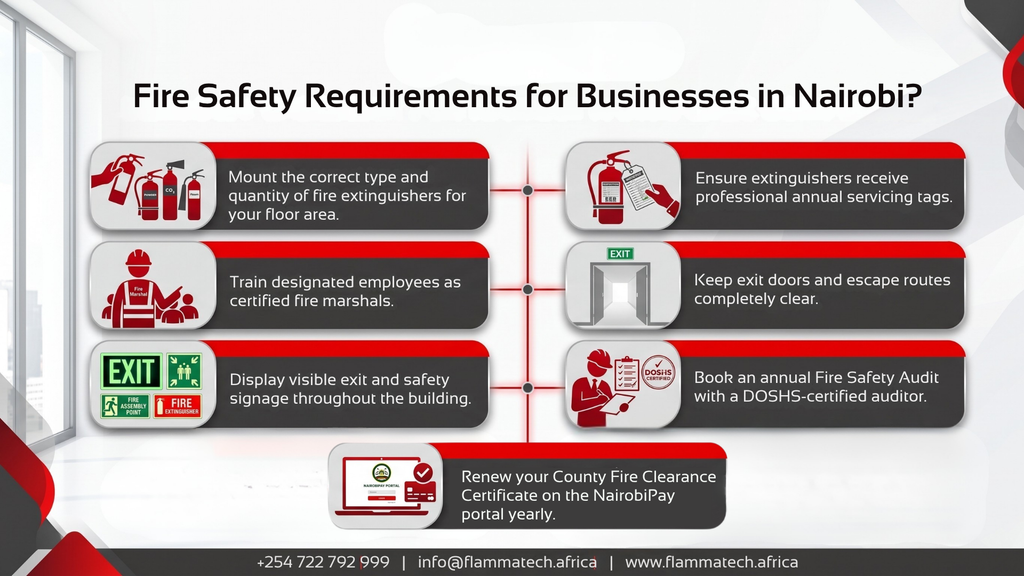
Summary Checklist for Nairobi Workplace Compliance
Need Help Getting Your Business Compliant?
Flammatech provides end-to-end fire protection services for commercial spaces, retail outlets, and offices across Nairobi—from equipment supply and annual refills to fire marshal training and compliance support.
Contact our team today to schedule an equipment check or request a quote for your business setup.
Flammatech Limited
📞: +254 722 792 999
📧: [email protected]
🌐: www.flammatech.africa